
Residue and Weight

There is a small restaurant my wife and I frequent. You can smell it from the parking lot. The garlic, cilantro, and onion. The kitchen is open and you can see the old Cuban man who is cooking your lunch. His wife greets us and takes us to our usual seat. She remembers where we like to sit. She gives my wife a hug.

The food is good, but I have had better food in places I never went back to. What brings us back is that someone is there. Two people built that room and they are standing in it. When the plate comes, it comes from them.

I have come to think a reader wants the same thing from a novel. I want to use two books to make the point.

The first was by Thomas Mann. The writing was the oddest I had ever seen, sentences that seemed to go on and on. I did not care for the book. But a few decades later, I can still recite the opening paragraph from memory. It was seared to my memory.

The second was Tolstoy. My mom put his short stories in my hands when I was a teenager. One of them is called Where Love Is. It is about a cobbler who works in a basement with a single window. He has buried his wife and children. One night he is told to look out for Christ who is going to come to him. The whole next day he looks out to the street and feeds and warms who ever comes by his window. That night he finds out who his visitor was. When I read this story as a teenager, it was very moving to me. This week, when it came back to me, it moved me again.

I have two words for what those books left in me. Mann left a residue. Tolstoy left a weight.

A residue is what stays in the memory. A rhythm, a line, a way of building a sentence. It is real, and I am thankful for it. Mann left a residue too. It is a heavy residue. A weight stays in you. You carry it with you, and you are not the same person for carrying it.

I remember Mann. I felt Tolstoy.

What gives the difference? It is not skill. Mann had every bit of skill a writer can have. The difference is this: In Tolstoy’s story I met someone. I felt the love of God and of fellow man coming through the pages, from a man long dead, who wrote in a language I cannot read. There was someone on the other end. A weight must come from somewhere. There was someone carrying it first.

Where does the writer find that to give? Not in the events. I wrote a boy of seventeen in a Connecticut workshop who loses his grandfather, and I would have said that I was never that boy. Then my wife read it. She showed me what I was not able to see. There were parts in that story that follow the loss of my father who died of a heart attack when I was sixteen. I had never put him in that story. I had never placed my grief on that page. I thought I was inventing. The events were invented. The grief was nearly fifty years old. It found its own way to that page.

A writer invents the events, but cannot invent the feelings beneath them. That is his, whether he knows it or not. I think it is the reason that that sorrow can be felt decades after it was lived.

It starts early. A child interacts with the world primarily through his body. He learns fear in the stomach and joy in the legs. He lies on his back under the sky and decides the clouds are kingdoms. He buries a loved one, and then, years later, holds a grandchild. And all of it goes to the same place. That place is where all the things he has felt andimagined live. It is a lifetime of things waiting to be handed to someone else.

Pope Leo wrote this year about the machines that now write. According to him, they “do not know from within what love, work, friendship or responsibility mean.” From within. That is where a weight comes from.

A machine can polish my prose and give me a line that I remember. It can even do all the editing. But it cannot hand me what it never carried.

So here is my position. No machine will ever write a word of my fiction. I will use a machine to check a date or fact the same way I will use the library. I will have a machine give me a list of mistakes the way I hand my wife a chapter and then I will fix the mistakes myself, but the sentences will be mine. They will be slow. I don’t want to write the book you read on a plane and forget in a week. I want to leave you a weight.

It may be surprising this is my position, considering my career has been dedicated to building machines. I still feel more comfortable feeding an electrical diagram to AI to check for me. My last company made intravenous fluids in a plant where no human hand touches the product. I designed it that way, because in that room the human hand is the danger. A bag of saline should have nothing of me in it.

A novel should have nothing else.

These are not contradictions, it is the same man asking the same question both times. What is the thing for? It is knowing the tool, where to use it, how to use it, and when it is the wrong tool for the job.

The world generally doesn’t see it that way yet. The question remains, “Did you use AI?” and it punishes those who answer honestly. I can’t just walk away from that. It’s what I am. I went back to the beginning and figured out what an honest answer looks like. The engineer’s take on everything I said here is a paper called “The Cost Is the Tell.” If you are ambitious you will find it here: The Cost Is the Tell: An Inventor’s Case for a Standard of…

You don’t have to read it to know what I think. Go to a restaurant where the people who own it are standing in the room. Years from now you may not remember what you ate. You’ll remember who fed you.

The Rivers of Christendom

When a question is hard, the sound method is to return to the earliest reliable evidence, establish what it says, and build forward from there. For the history of Christianity that method is patristics. The Didache, Clement of Rome, Ignatius of Antioch, Polycarp, Justin and Irenaeus were written within living memory of the apostles or a generation after; their authors were not describing a church but administering one. Read in chronological order, without later controversies read back into them, they establish what the earliest Christians believed and how they were organized. The method belongs to no confession. It is chronological, and chronology does not take sides.

Most charts of Christian history are not built this way. They are drawn from inside one tradition: a single trunk with branches that fall away in 1517, or a gap of eighteen centuries ending in a nineteenth-century restoration. Each is accurate about its own line and silent about the others. I could not find a chart that set out the whole development objectively, from primary sources, without a preference for one river over the rest. So I built one.

Read forward from the first century, the shape is not a tree but a river system. By about the year 100 there is a network of churches across the eastern Mediterranean and beyond, each claiming an apostolic founder. The chart grades those claims by attestation — solid where independent early evidence survives, dashed where the tradition is early but single-sourced, dotted where it is late — so that the viewer can distinguish what is known from what is said.

The method was applied in three steps. First, the four ancient tributaries were identified: the communions that trace an unbroken line to the apostolic churches and that had separated from one another before the end of the first millennium — the Church of the East (after Ephesus, 431), the Oriental Orthodox churches (after Chalcedon, 451), and the Roman and Constantinopolitan communions (estranged between 863 and 1204). Every later body descends from one of these four. Second, each separation was dated from the primary record — conciliar acts, correspondence and contemporary chronicles — and drawn as the gradual process the record shows rather than as a single event. Third, the modern traditions were placed on the stream they left, with their present-day size shown by width.

The result follows: every major Christian tradition from the apostolic age to 2026, drawn as a river system, with the councils, separations and revivals placed where the sources put them. It is designed as a 24 × 60 inch wall chart, to be read standing before it, so that any Christian can find his own river and see where it comes from.


The Rivers of Christendom — a historical chart of the development of Christian traditions, c. 30–2026, by Alex Lucio

The chart is published under a Creative Commons Attribution licence and permanently archived with a DOI. It may be downloaded, printed and taught from freely.

Cite as: Lucio, Alex (2026). The Rivers of Christendom — A Historical Chart of the Development of Christian Traditions, c. 30–2026. Zenodo. https://doi.org/10.5281/zenodo.23812043

Research, content, chronology and design by the author. Layout rendered with AI-assisted software under his direction.

We Are Not Windows. We Are Proposals.

The telescope aimed at Alpha Centauri shows you light that left the star four years ago. The eye aimed at this screen shows you photons that left it nanoseconds ago. Both are rendering the past. There is no such thing as seeing the present. There is only the best model your mind could build with the data that arrived.

This is not philosophy. This is physics. This is neuroscience. And it is the thing that artificial intelligence is about to make undeniable.

We have always assumed — without quite deciding to — that perception is reception. That the world sends a signal and we receive it. That seeing is a kind of contact. But the evidence from quantum mechanics, from neuroscience, from the study of consciousness itself, has been accumulating for decades toward a different conclusion: we do not receive the world. We propose it.

Every perception is a hypothesis. The brain does not passively accept incoming data — it generates a prediction about what the data should be, compares it to what arrives, and updates the model when they diverge. What reaches awareness is not raw reality. It is the brain’s best guess, rendered in the texture of experience.

David Bohm saw this. His implicate order was an attempt to articulate a reality that folds beneath what any single observer can access — a deeper structure from which the apparent world unfolds like a hologram. Wheeler called it the participatory universe: the act of observation does not witness events, it completes them. The physicist and the mystic have been circling the same formulation for a century.

Now we are building machines that observe continuously, at scale, without rest. The Vera C. Rubin Observatory in Chile is about to generate more astronomical data than humans can read — so we will build AI to summarize the sky. We are constructing minds to tell us what reality looks like, because the raw signal has exceeded our bandwidth.

If Wheeler was right, we have not just built a tool. We have added a new kind of mind to the act of creation.

The question this raises is not whether machines can think. It is what it means that we have built something that never stops proposing the world — that observes without fatigue, without sleep, without the gap between experience and perception that makes us, for better and worse, human.

We are not windows onto the world. We are proposals about it. The universe doesn’t need us to understand it. It needs us to stop insisting we stand apart from it.

Literature is how we practice that.

The Weight a Book Leaves

I grew up with a love for the sound of language before I understood why. Thomas Mann taught me that a sentence could have architecture — that the structure of a clause could carry meaning that the words alone could not. Hemingway taught me that silence inside a sentence carries as much weight as the words. I have been trying to find the space between them ever since.

The French Romantics gave me scale. Hugo and Dumas understood that a novel was a moral argument, not an entertainment. Les Misérables is not a story about a man who stole bread. It is a question about whether a person can be more than what was done to them, whether society’s judgment of a life is ever final, whether grace is available to those the world has written off.

You close that book and you carry Valjean. He is not a character you remember. He is a weight you keep. That is what great writing does. It does not inform you. It changes the density of who you are.

My mother introduced me to Tolstoy’s short stories when I was a teenager. I have been sitting with them ever since. Not because they are pleasant — they often are not — but because they are true in a way that stays in the body long after the mind has moved on. Literature holds this power. It is the only technology we have built that can transmit the weight of a life into another person. Not summarize it. Not describe it. Transmit it.

This is why I write fiction. Not to entertain, though I hope to. Not to instruct, though ideas will find their way in. But to leave something with the reader that they did not have before — a weight, a question, a resonance that belongs to them now as much as to me.

The Cave Was a Record

Fifty thousand years ago, two different kinds of minds were collecting the same shells. Not for food. For meaning. The hunger for symbol is older than our species. Maybe it is the species.

The discovery at Üçağızlı II Cave in Turkey — Neanderthals and Homo sapiens sharing tools, sharing objects, sharing culture across tens of thousands of years — keeps refusing the narrative we built about them. We spent decades constructing a story of inevitable conflict, of replacement, of the superior modern mind outcompeting the archaic one. The archaeology keeps telling a different story.

Friends. Not competitors. Not threats. Friends. Two different kinds of mind deciding to share a fire.

This is what keeps drawing me back to archaeology as a lane of inquiry. Not the artifacts themselves, though they are astonishing. But what they imply about the depth of the human impulse toward meaning-making. The cave was not just shelter. It was a record. The paintings were not decoration. They were thought, preserved in ochre and charcoal, outlasting everything else the painter knew.

We keep finding that the past is deeper than we thought. Every new site says humans arrived earlier, stayed longer, lived stranger and more interesting lives than our models allowed. The story of early humanity keeps getting stranger and more interesting. That usually means we are getting closer to the truth.

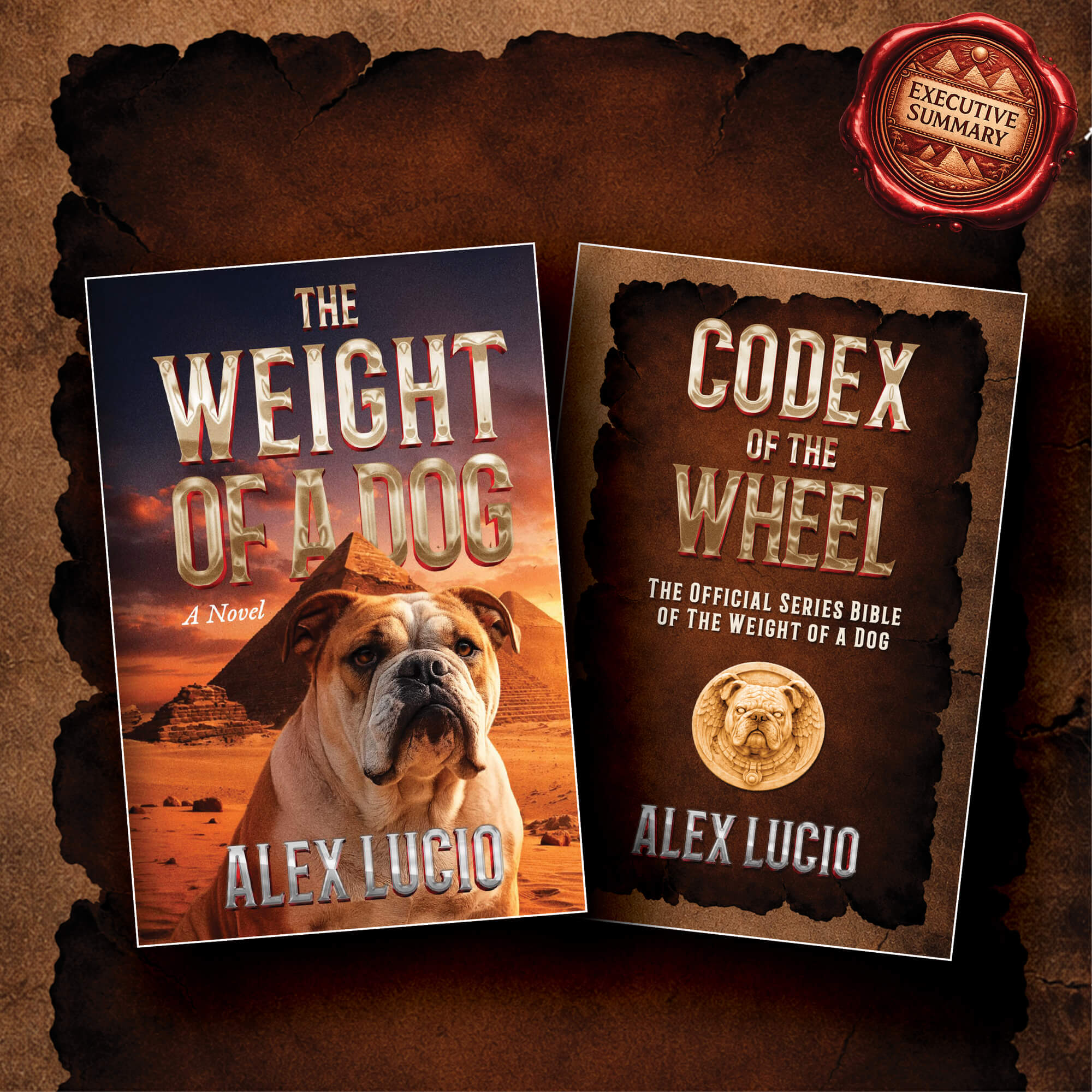
The Weight of a Dog

The unsettling truth about disclosure is not the spaceships. It is this: they are not coming. They have always been here. And if the phenomenon is interdimensional rather than interstellar — which the data demands — then it becomes indistinguishable from what every spiritual tradition in human history has been pointing at.

The Weight of a Dog tells this story through a sixteen-year-old boy and a sixty-pound English bulldog. Three families. Four centuries. One frequency running beneath all of it. The 19 Hz ghost frequency is documented infrasound research. The Schumann resonance is actively studied in relation to human brain wave patterns. This novel takes those documented facts and asks what would happen if someone built a machine from them thousands of years ago — and has been running it ever since.

Beneath the cosmic architecture, it is a meditation on grief and love. “Fear is just love looking for the door.” A line that belongs in eulogies. In therapy offices. In the quiet moments after the crying stops.